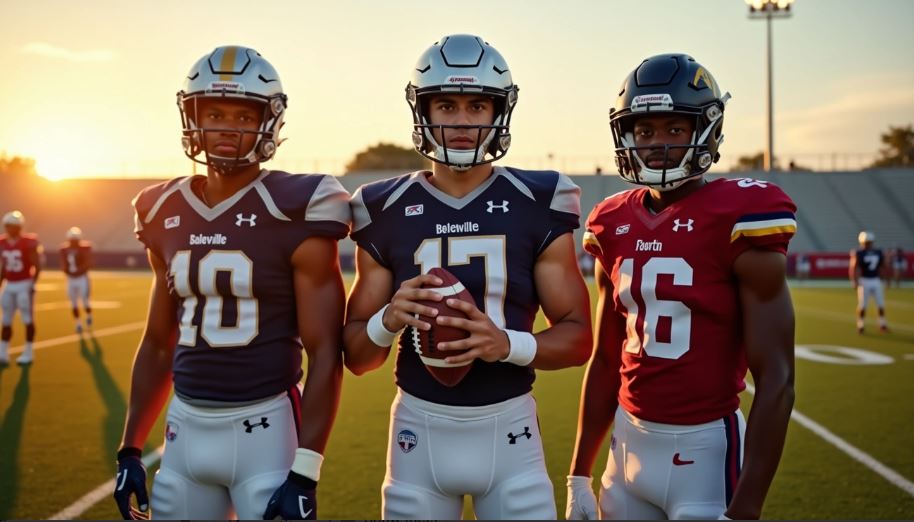
The 2025 high school football recruits landscape is taking shape with elite quarterback talent dominating the top spots. We’re seeing exceptional physical specimens at the quarterback position, with the top two recruits standing at 6’4″ and 6’3″ respectively, both carrying impressive 93 ratings. Meanwhile, St. John Bosco from Bellflower, California remains undefeated with a perfect 6-0 record, solidifying their position as the nation’s top-ranked high school team.
Looking at the class of 2025 football rankings, what stands out is not just the talent but also the financial implications for these young athletes. The top-ranked recruit already carries an estimated NIL value of $3 million, highlighting how the recruiting landscape has dramatically evolved. Furthermore, the top 2025 high school football recruits represent diverse positions, with defensive tackles, wide receivers, and cornerbacks all appearing in the top five spots. In Wisconsin, Arrowhead leads the way with a 4-0 record, followed closely by several 3-1 teams in the state rankings. As we analyze the top high school football players of 2025, we’ll break down not just who ranks where, but also examine the 2025 recruiting class rankings by position, geography, and college commitments that are reshaping the future of college football.
Top 10 players dominate 2025 football recruit rankings
The elite of the elite stand firmly atop the 2025 football recruit rankings, with a clear separation between the top-tier prospects and the rest of the class. The 2025 recruiting landscape features exceptional talents whose ratings and evaluations place them in rarefied air among high school football prospects.
Bryce Underwood leads the class of 2025
Michigan commit Bryce Underwood has established himself as the undisputed top prospect in the 2025 class, earning the #1 overall ranking across multiple recruiting services. Standing at an impressive 6’4″ and weighing 210 pounds, the Belleville, Michigan quarterback carries a perfect 100 rating from 247Sports and a stellar 93 rating from ESPN.
Underwood’s physical attributes tell only part of the story. Coaches have specifically praised his arm strength and pocket awareness, with Michigan offensive coordinator Chip Lindsey noting, “I think the surprise for me, [his] football knowledge is really high for a 17-year-old”. Indeed, Underwood has been described as a “football junkie” by his coaches.
Beyond his measurables, Underwood brings remarkable accomplishments, having finished his high school career with Michigan state records for total touchdowns (173) and passing touchdowns (143). Additionally, his estimated NIL value stands at an eye-popping $3 million, highlighting his marketability at the next level.
Keelon Russell and Elijah Griffin round out the top three
Keelon Russell, the Alabama-bound quarterback from Duncanville, Texas, holds firmly to the #2 spot in the 2025 rankings. At 6’3″ and 185 pounds, Russell matches Underwood’s elite 93 rating from ESPN. His overall performance since arriving on campus as a midyear enrollee has solidified his status as Alabama’s likely quarterback of the future.
Completing the top three is Elijah Griffin, a massive 6’5″, 300-pound defensive tackle from Savannah, Georgia, who has committed to the Georgia Bulldogs. Griffin carries a perfect 100 rating from 247Sports and a 93 rating from ESPN, making him the highest-rated defensive player in the class. Sources within the Georgia program believe Griffin could be their best defensive tackle addition since Jalen Carter (2020) and possibly “even already the most talented defensive lineman on the roster”.
Quarterbacks dominate the top five spots
Quarterback talent defines the upper echelon of the 2025 class. Among the top five players in the 247Sports composite rankings, three are quarterbacks:
- Bryce Underwood (#1 – Michigan)
- Keelon Russell (#2 – Alabama)
- Tavien St. Clair (#4 – Ohio State)
St. Clair, standing 6’4″ and weighing 225 pounds, gives the Buckeyes another elite QB prospect. Consequently, this quarterback-heavy class extends beyond the top five, with Julian Lewis (ranked #12 overall) headed to Colorado.
The quarterback talent in this class is primarily split between pocket passers like Underwood (listed as QB-PP) and dual threats like Russell (listed as QB-DT). Notably, Russell is specifically rated as the #1 dual-threat quarterback in the class.
The exceptional depth at quarterback has consequently reshaped recruiting strategies for top college programs, with Michigan, Alabama, and Ohio State all securing commitments from top-5 ranked quarterback prospects.
Position rankings reveal depth across the board
While the elite prospects at the top garner headlines, the depth of talent throughout the 2025 recruiting class reveals exceptional players across all positions. From quarterbacks to linebackers, this class showcases remarkable breadth and quality at every spot on the field.
Top quarterbacks in the 2025 recruiting class
Beyond the trio of Underwood, Russell, and St. Clair at the summit, the quarterback position shows impressive depth. Husan Longstreet, a 6’1″, 200-pound signal-caller committed to USC, ranks fourth among pocket passers. Julian Lewis, despite his 6’1″ frame, carries a 91 rating and has committed to Colorado. Other notable QB prospects include Akili Smith Jr. (Oregon commit), Matt Zollers (Missouri), and Antwann Hill (Memphis), all carrying impressive 83 ratings. Throughout the top 10 pocket passers, eight different states are represented, highlighting the nationwide distribution of quarterback talent.
Elite wide receivers making national impact
The wide receiver position may be the deepest in the 2025 class. Dakorien Moore from Duncanville, Texas tops the position rankings with a 98 rating. Kaliq Lockett (Sachse, TX) and Jerome Myles (Corner Canyon, UT) complete the top three receivers, all carrying elite 98 ratings. In fact, the 2025 class features 15 wide receivers with ratings of 94 or higher. Texas dominates receiver production with 7 of the top 25 wide receivers, followed by Florida with 5.
Offensive and defensive linemen shaping the trenches
On the defensive line, Elijah Griffin stands as the premier talent. The 6’5″, 285-pound Georgia commit combines quick athleticism with excellent technique and can effectively play either interior position. Following Griffin is Justus Terry, another Georgia product who uses his 6’5″, 275-pound frame to shed blocks effectively. Moreover, Iose Epenesa, a 5-star edge rusher from Illinois committed to Iowa, excels at setting the edge and stopping the run.
The offensive line features several standout interior linemen, including AJ Andrews from Spalding High School in Georgia. At 6’4″ and 305 pounds, Andrews dominates opposing defenders with excellent hand placement and leg drive.
Standout defensive backs and safeties
Kyle Hamilton of the Baltimore Ravens leads the safety rankings, showcasing versatility by earning at least 88.0 PFF grades in coverage, run defense, and pass rushing. Xavier McKinney follows closely with his exceptional coverage skills, recording eight interceptions and allowing just a 56.4 passer rating in coverage. Among high school prospects, numerous defensive backs have earned 4-star ratings across recruiting services, indicating exceptional depth at the position.
Rising stars at linebacker and tight end
Linebacker Jalon Walker from Georgia tops the 2025 linebacker rankings with an 87.4 rating. His explosiveness off the edge and development as an off-ball linebacker make him a complete prospect. Jihaad Campbell from Alabama ranks second with an 87.0 rating, demonstrating versatility in Alabama’s pressure packages. Demetrius Knight Jr. (South Carolina) rounds out the top three linebackers with an 85.9 rating, showcasing elite straight-line speed and natural blitz timing.
At tight end, the 2025 class features impressive physical specimens, with most top prospects standing between 6’4″ and 6’6″. This position group combines traditional blocking skills with modern receiving capabilities, making them valuable assets in today’s offensive schemes.
State-by-state breakdown shows Texas and Georgia lead talent pool
A geographical analysis of the 2025 football recruit rankings reveals distinct talent hotspots across America, with certain states consistently producing elite prospects at remarkable rates.
Texas produces most top 100 recruits
The Lone Star State dominates the 2025 recruiting landscape, producing an impressive collection of blue-chip talent. Among ESPN’s top 50 national recruits, Texas claims 8 players, more than any other state. Duncanville High School particularly stands out, producing both Keelon Russell (QB) and Dakorien Moore (WR), who rank #2 and #4 respectively in the national rankings. Beyond these elite prospects, Texas boasts remarkable depth, with 100 players rated 77 or higher according to ESPN’s evaluation system. This talent is primarily concentrated in metropolitan areas, with Houston, Dallas, and San Antonio serving as the main production centers. Particularly, North Shore High School in Houston has produced multiple top-tier recruits, highlighting the program’s developmental prowess.
Georgia and Florida follow closely
Georgia has firmly established itself as a premier talent-producing state, effectively joining what was once called the “Big Three” of Texas, Florida, and California. The Peach State has solidified this position through recent drafts and continues the trend with the 2025 class. Georgia’s top recruit, Elijah Griffin, a 6’5″, 300-pound defensive tackle from Savannah Christian Preparatory School, carries an elite 93 rating. Furthermore, Georgia features 10 players among the top 50 nationally, a remarkable achievement for a state with roughly one-third of Texas’s population. Julian Lewis (Carrollton) and Isaiah Gibson (Warner Robins) further exemplify Georgia’s exceptional talent pool.
Florida maintains its historical strength in producing football talent, ranking third nationally. The Sunshine State places 5 players in the top 50 national rankings, primarily from talent-rich South Florida.
California and Ohio maintain strong pipelines
California, though once considered part of recruiting’s “Big Three” alongside Florida and Texas, has experienced a relative decline in recent years. Nevertheless, the Golden State still produces significant talent—just distributed differently than before. What distinguishes California is the wide dispersion of its talent, with 95 NFL draft picks from the state over a recent five-year period coming from 77 different high schools. Los Angeles, the Bay Area, and San Diego account for most of California’s football talent, with Southern California representing 72.6% of the state’s recent draft picks.
Ohio rounds out the top five talent-producing states, with strong programs particularly in the Cincinnati and Cleveland areas continuing to develop Division I prospects at consistent rates.
College commitments shift team recruiting class rankings
The battle for elite 2025 high school football recruits has dramatically altered the college football recruiting landscape, with premier programs securing commitments from top talent throughout the nation.
Michigan, Alabama, and Ohio State land top prospects
Michigan scored a recruiting victory when five-star quarterback Bryce Underwood flipped his commitment from LSU in November. This seismic in-state pledge gives the Wolverines the #1 overall prospect in the 2025 class. Michigan’s recruiting momentum extends beyond Underwood, as they’ve secured Andrew Babalola, a highly-rated offensive tackle.
Alabama continues its recruiting prowess under new head coach Kalen DeBoer, who has signed a trio of top-15 recruits in his first full recruiting cycle. Quarterback Keelon Russell, the #2 overall prospect, headlines Alabama’s third-ranked class. Alongside Russell, offensive lineman Michael Carroll and cornerback Dijon Lee round out the Crimson Tide’s top-15 haul.
Ohio State has compiled an equally impressive group, primarily featuring quarterback Tavien St. Clair (#4 overall) and cornerback Devin Sanchez. The Buckeyes currently hold 27 commitments for 2025, including five defensive linemen and strong secondary reinforcements.
How commitments affect 2025 recruiting class rankings
The SEC dominates college football recruiting rankings, securing seven of the top 10 classes in the 2025 cycle. However, the Big Ten trio of Ohio State, Michigan, and Oregon has disrupted the SEC’s stranglehold atop the rankings.
Texas currently leads all programs with the #1 ranked recruiting class across multiple services. The Longhorns have bolstered their defense with a pair of five-star safeties, Jonah Williams and Kade Phillips. Ultimately, 12 of Texas’ commitments play defense, highlighting their focus on defensive reinforcements.
Rankings fluctuate significantly throughout the recruiting cycle. As of July 2024, the consensus rankings showed Ohio State at #1, Alabama #2, and Georgia #3. Yet by February 2025, Texas had claimed the top spot across all major recruiting services.
Which schools are trending upward?
Several programs have gained momentum in recent months. Surprisingly, Rutgers (#15), TCU (#17), and Wisconsin (#18) have cracked the top 20 despite traditionally recruiting outside that range.
Georgia Tech has made a significant leap, reaching #22 in the rankings after previously struggling to land elite talent. Kentucky (#21) and South Carolina (#23) have similarly outperformed expectations.
Interestingly, 24 of the top 25 recruiting classes already have 12 or more commitments, with 11 programs securing 20+ commits. Currently, 16 schools are building “contender” classes with Blue Chip Ratios (percentage of four and five-star recruits) above 50% – a threshold considered necessary for championship contention.
Programs like USC, Kentucky, and Missouri hover near this threshold at 40+% blue-chip recruits but will need transfer portal assistance to reach championship-caliber roster construction.
Ranking methodology explained by recruiting experts
Behind every player ranking lies a methodical evaluation process that combines technology, expert analysis, and consistent monitoring throughout high school careers. The 2025 football recruits are evaluated through sophisticated systems designed to provide objective assessments of their potential.
How composite scores are calculated
The 247Sports Composite ranking system aggregates ratings from three major recruiting services as of July 2025: 247Sports, ESPN, and On3, with each service accounting for exactly one-third of the formula. This proprietary system converts average industry ranks into a linear composite index capping at 1.0000, indicating a consensus #1 prospect across all services. Rather than assigning a fixed number of five-star recruits, the Composite uses a rating threshold—any player with a score of 0.9834 or higher earns five-star designation.
Team rankings utilize a Gaussian distribution formula where each team’s best recruit is worth the most points. Hence, this mathematical approach ensures all commits contribute value to the team’s score without excessively rewarding programs that simply accumulate more commitments than others.
Role of scouting reports and game film
Although testing numbers and in-person evaluations matter, game film represents approximately 60% of a prospect’s total grade. As one 247Sports analyst notes, “What are these prospects able to do in pads and under the lights? We grind through the tape. That’s the baseline”. Throughout this process, experts compile multiple data points across three to four years, tracking prospects from freshman through senior seasons.
Many recruiting services now use NextGen software—the same technology utilized by NFL organizations and College Football Playoff contenders—to store comprehensive notes on prospects from ninth grade through twelfth grade.
Why rankings change throughout the season
Player evaluations represent an ongoing assessment rather than a singular event. Typically, rankings follow a structured update schedule: initial top 100 after freshman year, full Top247 after sophomore year, plus multiple updates during junior and senior seasons. Even minor rating adjustments can create ripple effects across team rankings.
Rating changes don’t necessarily reflect new scouting opinions or player performance—sometimes they simply indicate recalibration due to updated data sources.